
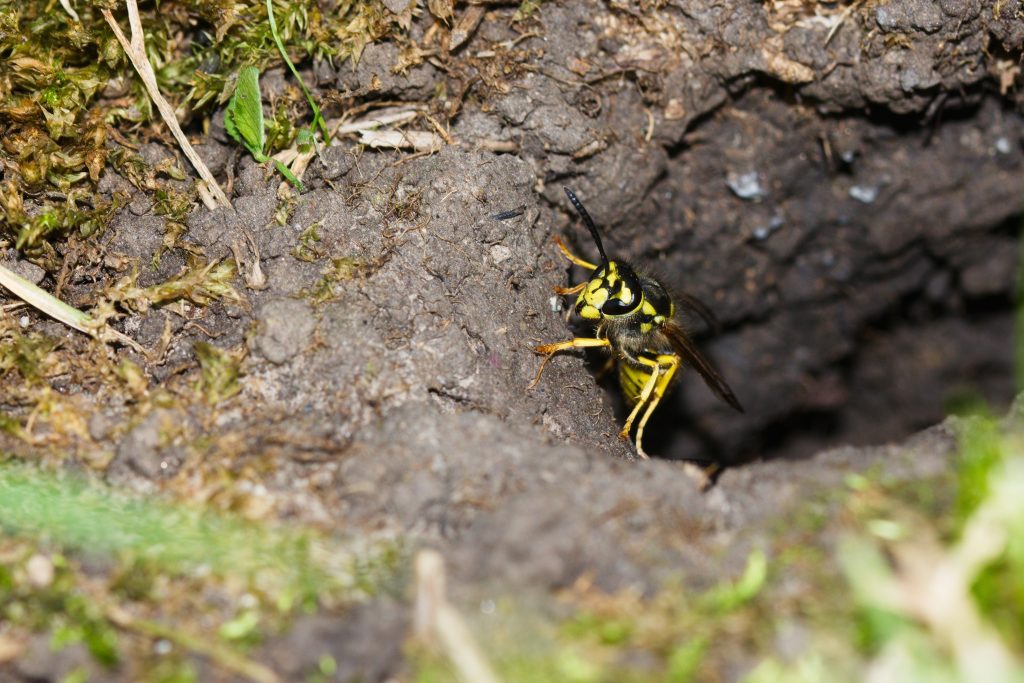
The yellow jacket is the famed insect of the wasp community. They are highly aggressive, their evolution honed for millions of years and they prey on humanity’s most important asset: Bees. Wasps are notorious hunters of bees and can kill an entire hive in hours. They use location mapping hormones to leave a trail as they fly and then activate an alarm hormone when they find a bee’s nest. At that point, it takes very little time for a massive swarm of wasps to descend on the bee nest. While bees are not defenceless against wasps, they too have stingers that can kill a wasp, they are heavily underpowered. The wasps can sting endlessly and will do so. They will bite the bee’s heads off and use the bodies to feed their young. They will eat the honey and the larva and will take the royal jelly back to the nest for their queen to consume. If this sounds like a war where one side always wins then you are correct. Bee’s were once so plentiful that wasps could never kill them all, but since the invention of neonicotinoid pesticides, a pesticide that is very safe but a severe danger to bee populations, the bee population across the world has been dropping. With their predators now comparatively larger in number, they do not stand a chance. While Europe has banned these chemicals Canada still has not. This means that yellow jacket wasps could, one day, win their fight against the bees and cause a total extinction with the help of Neonics.
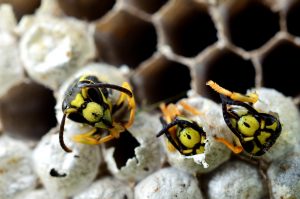 The yellow jacket life cycle is surprisingly simple and extremely dogmatic. The queen rules all she sees entirely. Every worker is a sterile female with no purpose but to serve their queen. The queen starts her journey the year before. She will have been born in the late fall as the winter cold approaches. She and her fertile sisters will do a mating dance with the fertile males also produced at that time. The males will die straight after and the females will leave the nest and find a place to hibernate through the winter. The original queen will die and so will all her workers, ending her one-year life cycle. This process continues every year like clockwork with each wasp nest multiplying as the years go on. This means if you had a wasp nest on your property that was not treated with either domestic or commercial-grade products, then you may now have dozens of nest on your property, or even what is called a super nest, a multigenerational nest on the inside walls of your home. So large you would have to renovate the home to kill the nest and remove it. This happens because human homes are warm enough for wasps to easily survive the winter. When the workers fail to die off they will be able to keep working and with the new queens being born and not needing to hibernate they can join in and birth sterile workers together. The sterile worker wasp is the one to be afraid of, they are highly aggressive and protective of their nests.
The nest itself is a warped reality compared to what humans consider a structure. It is a honeycombed shape made up of birthing chambers for baby wasps, and in large nests, there will be multiple conduits and atriums where tens of thousands of baby wasps can be laid. These birthing pods are used for the sterile workers and then eventually for the fertile males and females. A normal-sized underground nest is about the size of a basketball and is often made in old rat burrows because the dirt has already been patted down by the rat. All wasp nests have an entry point that is very small and very hard to access. The entry point for a ground nest will be coated in pollen and will have yellow tracks all over it. A nest inside of a wall is most likely going to be a hole in the brick mortar or behind the vinyl or aluminum siding. They can enter through weep vents, fascia vents in the roof and just about any small opening your home could have. So preparation is 99% of the work when dealing with wasps.
